
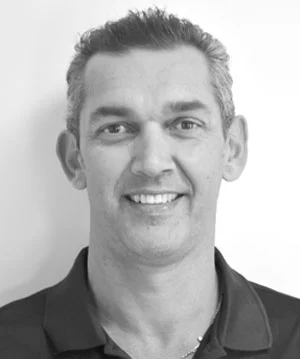
An Interview with Michael Vadiveloo
Today I interviewed Michael Vadiveloo, a Specialist Sports Physiotherapist, as awarded by the Australian College of Physiotherapists in 2011. Graduating physiotherapy in 1986, Michael is the owner of City Baths Spinal & Sports Medicine Clinic and Energise Physiotherapy & Clinical Pilates Studio in Oakleigh. He worked for St Kilda football club from 1991 to 2005 and travelled with various Australian AFL representative teams. His area of specialisation is the knee with a particular interest in rehabilitation of the lower limb kinetic chain, specifically for knee injury and pain. Michael discusses his career path, challenges for new graduate physiotherapy and the future of physiotherapy.
Michael, why did you choose to become a physiotherapist?
I wanted to work in sports, so I did Human Movement Studies at Melbourne Uni. I was interested in running exercise programs for employees in large companies and factories, however that idea was a bit ahead of its time. In my last year of my science degree (Human Movement), I did a study on knee injuries and I thought I would pursue this area with respect to treating and rehabilitating people. Medicine was going to take seven more years so I chose to do physiotherapy. So no inspirational story unfortunately!
How does working in private practice compare to St Kilda football club?
Footy clubs are a great environment to observe the mechanism of injury, provide acute treatment, follow injury progress and rehabilitate players to return to play. You have an ability to intervene and influence the player from acute injury to return to play. In an AFL setting you have access to a multidisciplinary team of medicos, exercise physiologists, masseurs and other allied health practitioners. You are also at the elite end of the sporting pyramid so you need to be on the cutting edge of all management practices for all injuries. There are rarely financial constraints. This is different to a clinic, where you might see a patient every week or so and you don’t have as much control over their daily progress. You also don’t have the ability to observe changes or monitor progress of your intervention as often.
Why did you choose to specialise in Sports Physiotherapy?
I’d been a physiotherapist for 24 years. So in 2010 an opportunity arose where I could sit the specialisation exam for the Australian College of Physiotherapists without going through a formalised program because of my experience in elite level sport. So I equivocated for about six months then joined in with the Melbourne study group at the time (Paul Visentini, Jane Rooney and Wendy Braybon). The motivation to do it: I’d done football at a high level with St Kilda for 14 years, I was now treating in the clinic full time and I felt like I needed another challenge to improve myself and my skills. The specialisation process ended up being a fantastic stimulus for me to continue to improve being a physio, improve my knowledge and ensure I was the best physio I could be.
As a group we’d prepare 10 questions every week with references and share that knowledge. We’d meet every one to two weeks and do mock exams, go through prepared questions and grill each other to test our skills and knowledge. The outcome was an amazing increase in my knowledge and skill acquisition and it allowed me to interact with three other well known Melbourne physios who I continue to be grateful to for their help and friendship.
What was the biggest change in you following specialisation?
I’m a much better physio. I was a pretty good diagnostician and I felt I had really good hands. Clinically in my assessment, decision making and treatment I think I was a very good physio but my evidence-based knowledge and ability to justify my treatment was not that great. It has been greatly enhanced by the process. My desire to teach and pass on the knowledge I have gleaned from the process and my colleagues has also been increased. I feel I have something to offer, in terms of imparting knowledge to other physios.
Any advice for new graduate physiotherapists?
I think graduate physios, just as I did, need a lot of mentoring and teaching if they are to enter into private practice. The biggest thing they have to learn is that they have limited knowledge and understanding of pathologies and the natural progress of these pathologies. They also have to be aware that their hands skills are limited (often due to factors out of their control in the undergraduate programs) and will need to be improved. This will happen with mentoring from more experienced physiotherapists and by undertaking post-graduate courses.
That reminds me of something Jeffrey Boyle (Fremantle Football Club Physiotherapist) said, with new graduates always wanting to jump into the elite level but they need to put in the hard yards first, learn their craft, make mistakes and become competent.
How has physiotherapy changed since you graduated?
Treatment of injuries is so different now. When I started, if you had an ACL rupture you were put in plaster for six weeks, our biggest challenge was getting ROM back, which used to kill the patients. The progression in techniques and knowledge of injury pathology is now much greater. I didn’t have access to MRI when I first started, we just had x-ray and CT. We can now MRI joints and soft tissues and ultrasound scan soft tissues when required to help determine and verify diagnoses. Electrotherapy, when I started, was almost a primary intervention and is rarely used by me now. Physiotherapists have placed a greater emphasis on our hand skills and exercise prescription. Times to treat patients; when I first started it was a 15 minute appointment, now a lot of places do 30 minutes. So we’ve increased our times but have we proportionally increased our fees. My biggest annoyance is the undervaluation of the service we provide. Again, when I first started there was no difference between a titled fee and a normal fee, so when I became Sports Titled I made sure I charged more to allow differentiation to the public. I think it rewards physios who do seek further qualifications and like any other profession the public should recognise and pay for experience, knowledge and quality.
Is there anything you would change, as a Specialist?
The disappointing thing with being a specialist is one of our roles was to act as a secondary referral base for physios with difficult clients. We should be seen as consultants, similar to an orthopaedic specialist, who can provide a specialist opinion advising the recommended continued management. We would get the patient in (with the treating physiotherapist if they desire), assess them, write a letter to the physio with our recommendation on further intervention and send the patient back to their original treating physio for continued management. I don’t think this has been pushed, either by the College or APA, which is disappointing. There may be a reluctance, or probably more a lack of knowledge of our role and that this option exists. There’s possibly a fear that we won’t return patients but we respect our fellow physiotherapists and are not there to poach their patients. We want to help our profession to improve in the management of their clients.
How can physiotherapy improve from here?
I think the physiotherapy profession needs to continue to advertise our role to the public at large. As a physio it’s very hard to convey to the public what we do. We have so many different roles in treating the public from paediatrics to geriatrics. We’re such a disparate group of practitioners working in different fields it makes it difficult to be heard with one voice. Within the private practice area there are chiropractors, osteopaths and other allied practitioners competing for the same clients. We need to be able to sell our profession and abilities better and differentiate ourselves in the market. There is still a perception in the public that if asked the question “If you have a bad back, who would you go to?” they’d probably say chiro or general practitioner. I think selling ourselves, our abilities and our profession is still our biggest goal. In saying that, our evidence based knowledge combined with our hands on skills and exercise prescription has to be better. I think this is slowly occurring.
Thank you Michael, this has been extremely illuminating and provides some great points for future conversation.